The Real Cost of an Accountant in Reading: Why Fixed Fees Beat Hourly Rates for SMEs
Understanding accountant costs in Reading is essential for making informed business decisions. Whether you're a freelancer managing your first Self-Assessment, a limited company director overseeing VAT and payroll, or a sole trader meeting HMRC deadlines, it's crucial to understand your accountant's fee structure alongside the services provided. Hourly billing can result in unpredictable expenses, with charges for every call, query, and correspondence, often discouraging business owners from seeking necessary support. Fixed-fee accounting resolves this issue by offering a clear, agreed monthly cost, enabling confident budgeting and open communication with your accountant. At TX Accountants Ltd, we provide comprehensive tax and accounting packages, including Self-Assessment, Partnership Tax Returns, and Limited Company year-end accounts with integrated bookkeeping software, all at transparent, fixed fees with no hidden costs. Our fully cloud-based service ensures expert support anywhere, with a guaranteed 24-hour response from HMRC-authorised, Chartered Certified Accountants. This guide explores typical accountant costs in Reading, the factors influencing these fees, and why a fixed-fee model offers superior value for SMEs, freelancers, and self-employed individuals across the UK.
Year-End Tax Advice for Small Businesses: 2026/27 Guide
Year-end tax isn’t simply about submitting your tax return before the deadline. There is an important difference between tax compliance and tax. Tax compliance means meeting your legal obligations, keeping appropriate records and submitting the required returns.
Tax plan is more proactive. It means reviewing your financial position early enough to understand your options and make decisions that could improve your overall tax position.
The UK tax year runs from 6 April to 5 April. For 2026/27, that means the tax year runs from 6 April 2026 to 5 April 2027. Before the tax year ends, business owners should consider:
- Salary and dividends
- Business profits
- Allowable expenses
- Pension contributions
- Capital expenditure
- Corporation Tax
- Personal tax exposure
- Capital Gains Tax
- Cash reserves
- Bookkeeping
- Available tax allowances and reliefs
The earlier you review these areas, the more time you have to make sensible decisions.
Accountant Fees in Reading: What Should You Expect to Pay?
Accounting fees in Reading vary considerably depending on the firm and the services included.
Some accountants charge by the hour, while others offer fixed monthly or annual packages. Fixed-fee accounting can make budgeting easier because you know your expected costs before work begins.
As a general guide, straightforward accounting services may start from around £60–£100 per month, while more comprehensive packages can cost considerably more depending on the business.
Hourly rates can also vary. The important consideration is not simply the hourly rate but what you receive for the total fee.
A lower hourly rate may not necessarily mean a lower overall cost if the work takes longer or additional services are charged separately.
What Affects the Cost of an Accountant?
Several factors can influence your accounting fees:
- Your business structure
- Annual turnover
- Number of transactions
- VAT registration
- Payroll requirements
- Number of employees
- Bookkeeping requirements
- Complexity of your tax return
- Property or rental income
- CIS requirements
- Business expenses
- Management accounts
- Tax requirements
- The amount of support you require
A sole trader with straightforward income and expenses will generally have different accounting requirements from a growing limited company with employees, VAT and regular bookkeeping.
How Much Does a Sole Trader Accountant Cost in Reading?
For a sole trader, the main accounting requirement is often a Self-Assessment tax return. A Self-Assessment tax return is a yearly submission to HMRC detailing an individual’s income and expenses to calculate the tax owed.
For a straightforward Self-Assessment return, you may see accountant fees of around £150–£250 per year, although actual fees vary between firms and depending on the complexity of your circumstances.
Additional work can increase the cost. For example, your accountant may need to deal with:
- Multiple sources of income
- Property or rental income
- CIS deductions
- Business expenses
- Dividend income
- Foreign income
- Investment income
- Complex tax calculations
- Previous-year corrections
If your circumstances are more complicated, it is worth asking exactly what is included in the quoted fee before comparing accountants.
How Much Does a Limited Company Accountant Cost in Reading?
Limited companies generally require more ongoing accounting work than sole traders. Depending on your circumstances, an accounting package may include:
- Annual accounts
- Corporation Tax return
- Director’s Self-Assessment
- Bookkeeping
- VAT returns
- Payroll
- Confirmation Statement support
- Tax advice
- HMRC correspondence
- Business advice
Basic limited company accounting packages may start around £60–£100 per month, while businesses requiring bookkeeping, VAT, payroll and additional advisory services may pay more.
For example, a small company with straightforward transactions may require a relatively simple package, while a growing company with employees, VAT and regular bookkeeping will need more comprehensive support.
The best approach is to compare the services included in the package, rather than comparing monthly prices alone.
Typical Accounting Costs in Reading
Business Type | Typical Cost | Common Services |
Sole Trader | £150–£250+ per year | Self-Assessment tax return |
Small Limited Company | £720–£1,800+ per year | Accounts, Corporation Tax and basic compliance |
Limited Company with VAT & Payroll | £1,200–£3,000+ per year | Accounts, VAT, PAYE, bookkeeping and tax |
Complex Sole Trader/Landlord | £300–£600+ per year | Self-Assessment, property income and additional tax work |
These figures are indicative rather than fixed market rates. Your actual accountant fees in Reading will depend on your business and the services you require.
Why Are Accountants in Reading More Expensive Than Online Accountants?
Reading sits within the Thames Valley and is closely connected to London’s business and professional-services economy.
This can influence operating costs for traditional accounting practices, particularly firms with physical offices, larger teams and higher overheads.
However, the rise of cloud accounting has changed how businesses can work with accountants.
Cloud accounting refers to the use of online platforms to manage financial records and collaborate with accountants remotely. A Reading business does not necessarily need to visit an accountant’s office every time it needs help.
Cloud-based accounting allows businesses and accountants to work together remotely using platforms such as Xero, QuickBooks or FreeAgent.
This can provide:
- Real-time access to financial information
- Faster document sharing
- Easier bookkeeping
- Digital communication
- Better visibility of business performance
- More efficient accounting processes
For many small businesses, freelancers and limited company directors, this can make professional accounting support more convenient and predictable.
Cheap Accountant vs. Good-Value Accountant
When comparing accountants in Reading, it can be tempting to choose the lowest quote. However, price should not be the only consideration.
A very cheap accounting service may provide basic compliance but little ongoing support. If your accountant only prepares your accounts once a year, you may miss opportunities to improve your tax position or manage your cash flow.
A good-value accountant should help you understand:
- What tax you are likely to pay
- Which expenses you can legitimately claim
- When your tax payments are due
- Whether your salary and dividend structure is appropriate
- Whether your business structure remains suitable
- How your cash flow is performing
- What financial decisions you should consider next
The objective should be value rather than simply the lowest fee.
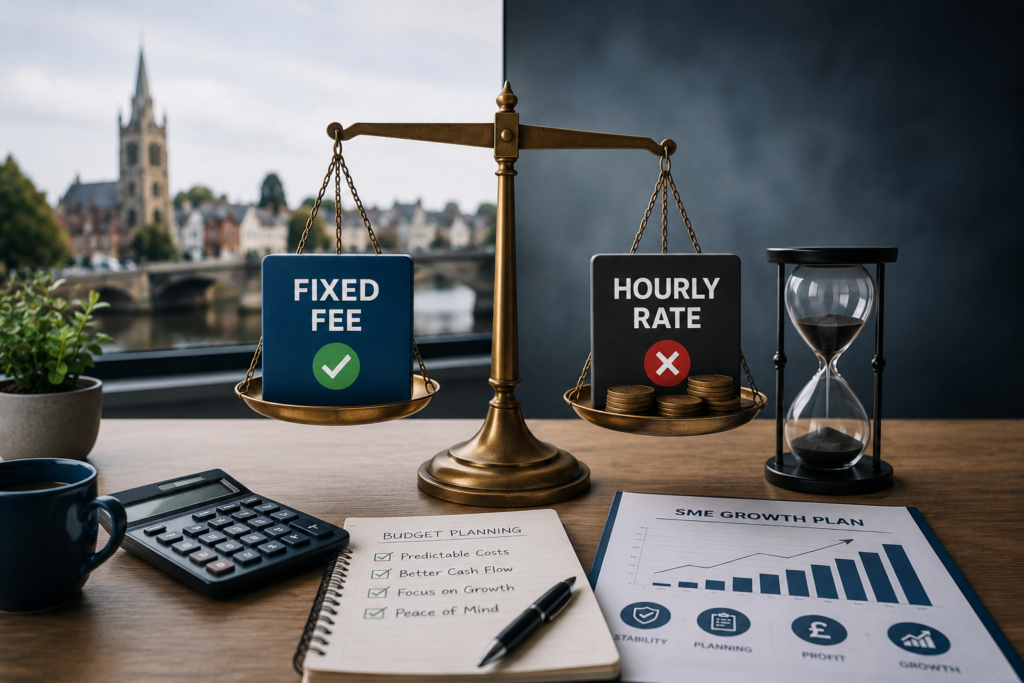
Fixed-Fee Accounting vs Hourly Rates
Traditional accounting services are sometimes charged according to the amount of time an accountant spends on your work.
For businesses, this can make costs harder to predict. You may hesitate to contact your accountant because you are concerned that every question will result in an additional charge.
Why Fixed Fees Can Be Better for Small Businesses
A fixed-fee accounting package gives you greater certainty about your regular accounting costs. Fixed-fee accounting ensures that businesses pay a predetermined amount for specified services, eliminating unexpected charges and aiding in budgeting. Depending on the package, it may cover agreed services for a fixed monthly or annual amount.
The main advantages include:
1. Predictable Costs
You know how much you are expected to pay each month, making it easier to manage your business budget.
2. Easier Communication
If agreed support is included in your package, you can contact your accountant when you need help without worrying about an unexpected hourly bill for every conversation.
3. Better Tax Advice
Regular communication can help you identify tax and financial issues before they become problems.
4. Less End-of-Year Stress
Keeping your accounting records up to date throughout the year can make year-end accounts and tax returns much easier to manage.
However, always check what is actually included in a fixed-fee package. Some services may still be charged separately.
What Services Should Be Included in an Accounting Package?
When comparing accounting firms in Reading, ask for a clear breakdown of what your fee covers. A limited company package might include:
Annual Accounts: Preparation and submission of your company’s annual accounts.
Corporation Tax: Preparation and filing of the company’s Corporation Tax return.
Bookkeeping: Recording and organising your business income and expenses.
VAT Returns: Preparation and submission of VAT returns where applicable.
Payroll: Processing employee or director payroll and associated reporting.
Self-Assessment: Preparation of the director’s personal tax return where included.
HMRC Support: Assistance with HMRC correspondence and tax-related queries.
Tax: Advice designed to help you understand and plan your tax position.
Not every accountant includes all these services in one package, so always ask for a written breakdown before agreeing to a price.
Can an Accountant Actually Save You Money?
An accountant is not simply a cost of running a business. The right accountant can potentially help you avoid unnecessary tax and make better financial decisions. For example, they may help you identify:
- Allowable business expenses
- Available tax reliefs
- More efficient remuneration strategies
- Pension opportunities
- Capital expenditure considerations
- VAT issues
- Corporation Tax opportunities
However, tax depends on your individual circumstances and should always be based on current legislation.
Salary and Dividend for Limited Company Directors
For many owner-managed companies, deciding how to take money from the business can be an important part of tax.
Salary and dividends are taxed differently, and the most suitable approach depends on factors such as company profits, personal income, National Insurance and other circumstances.
For the 2026/27 tax year, dividend tax rates above the £500 dividend allowance are:
- 10.75% for basic-rate taxpayers
- 35.75% for higher-rate taxpayers
- 39.35% for additional-rate taxpayers
These rates apply from 6 April 2026.
Therefore, directors should not automatically assume that the same salary and dividend strategy will remain optimal every year. A review of your position can help you make decisions based on your actual circumstances.
When Should You Hire an Accountant?
You do not necessarily need to wait until your business becomes large before getting professional accounting support. An accountant can be particularly useful when:
- You are starting a business
- You are moving from sole trader to limited company
- Your turnover is increasing
- You are registering for VAT
- You are employing staff
- You need help with payroll
- Your tax affairs are becoming complicated
- You are buying business assets
- You are considering taking on a business partner
- You need help with tax planning
- You have received an HMRC notice
Getting advice early can help prevent avoidable problems later.
What to Look for When Choosing an Accountant in Reading
Choosing an accountant should involve more than comparing prices. Here are several important things to consider.
1. HMRC Agent Status
Ask whether the accountant is authorised to act as your agent with HMRC.
An authorised tax agent can deal with HMRC on your behalf where appropriate.
2. Relevant Experience
Look for an accountant who understands businesses similar to yours.
For example, contractors, landlords, construction businesses, freelancers and limited companies may have very different accounting requirements.
3. Clear Pricing
Your accountant should explain exactly what your package includes and identify any additional charges.
4. Cloud Accounting
Cloud-based accounting can make it easier to share records, track financial information and communicate with your accountant.
5. Communication
Consider how quickly the accountant responds to questions and how you will communicate with them.
6. Proactive Advice
A good accountant should not simply prepare accounts after the financial year has ended.
You should be able to discuss tax planning, business decisions and financial issues during the year.
7. Local Understanding
If your business operates in Reading, working with an accountant who understands the local business environment can be useful, particularly if you value face-to-face or locally focused support.
Questions to Ask Before Hiring an Accountant
Before choosing an accountant in Reading, ask:
What is included in the monthly fee?
Make sure you understand exactly which services are included.
Are there any additional charges?
Ask whether services such as bookkeeping, VAT, payroll, tax advice or HMRC correspondence cost extra.
Do you offer fixed-fee accounting?
If predictable costs matter to you, ask whether the firm offers a fixed monthly package.
Who will manage my accounts?
Find out whether you will have a dedicated accountant or primarily deal with a wider support team.
How quickly do you respond to queries?
Communication can become particularly important when you have an HMRC deadline or urgent tax issue.
Do you use cloud accounting software?
Ask which platforms the firm supports and whether software costs are included.
Do you provide tax planning?
Compliance and tax planning are different services, so clarify what advice is included.
Is an Online Accountant Better Than a Local Accountant in Reading?
There is no single answer.
It depends on how you prefer to work.
A traditional local accountant may be preferable if you want regular face-to-face meetings.
An online accountant may be more convenient if you prefer digital communication, cloud software and remote access.
For many modern businesses, the distinction between “local” and “online” is becoming less important.
What matters most is whether the accountant understands your business, communicates effectively and provides the services you actually need.
Accounting Costs for Growing Reading Businesses
As your business grows, your accounting requirements can become more complicated. A business may start with basic bookkeeping and annual accounts but later need:
- VAT returns
- Payroll
- Management accounts
- Cash-flow forecasting
- Corporation Tax planning
- Budgeting
- Business restructuring advice
- Financial reporting
- Funding or finance support
This means accounting fees can increase as your business becomes more complex. That is not necessarily a negative. The right accounting support should scale with your business and provide additional value as your financial responsibilities increase.
Don't Choose an Accountant Based on Price Alone
When comparing accountant fees in Reading, it is understandable to look for an affordable option. But saving £20 or £30 per month may not be worthwhile if you receive limited support or miss important tax-planning opportunities. Instead, consider the total value of the service.
Ask yourself:
- Will this accountant keep me compliant?
- Will I understand what I am paying in tax?
- Can I contact them when I need help?
- Are the fees transparent?
- Can they support my business as it grows?
- Do they understand my type of business?
These questions can help you compare accounting firms based on value rather than price alone.
How Much Does an Accountant Cost in Reading? Key Takeaways
Accounting fees in Reading depend heavily on your business structure and the services you require. The cost of an accountant in Reading is primarily influenced by the type of business you operate and the specific services you need.
As a broad guide:
- A straightforward sole trader Self-Assessment may cost around £150–£250+ per year.
- Basic limited company accounting packages may start around £60–£100+ per month.
- More complex businesses requiring VAT, payroll and bookkeeping will generally pay more.
- Fixed-fee packages can make accounting costs easier to budget.
- The cheapest accountant is not always the best-value accountant.
- Tax planning and proactive advice can be just as important as compliance.
- Cloud accounting can make working with an accountant faster and more convenient.
- Always confirm exactly what is included before accepting a quote.
The right fee depends on what your business actually needs.
Looking for a Fixed-Fee Accountant in Reading?
If you are looking for an accountant in Reading who can provide clear pricing and ongoing accounting support, TX Accountants Ltd can help. We provide accounting and tax services for businesses and individuals, including:
- Self-Assessment tax returns
- Limited company accounts
- Corporation Tax
- Partnership Tax Returns
- Bookkeeping
- VAT support
- Payroll
- Tax planning
- HMRC support
- Cloud-based accounting
Our aim is to make accounting straightforward, transparent and easier to manage. Rather than waiting until the end of the year to deal with your accounts, we can help you stay organised throughout the year and understand your financial position.
Get a Transparent Accounting Quote
Every business is different, so the best way to understand your accounting costs is to discuss your requirements.
Contact TX Accountants Ltd today for a transparent, fixed-fee quote for your Reading business.
Find out what accounting support you need, what it will cost and how we can help you stay on top of your tax and accounts.
No unnecessary complexity. No unclear pricing. Just straightforward accounting support for your business.
Visit TX Accountants Ltd to get started.